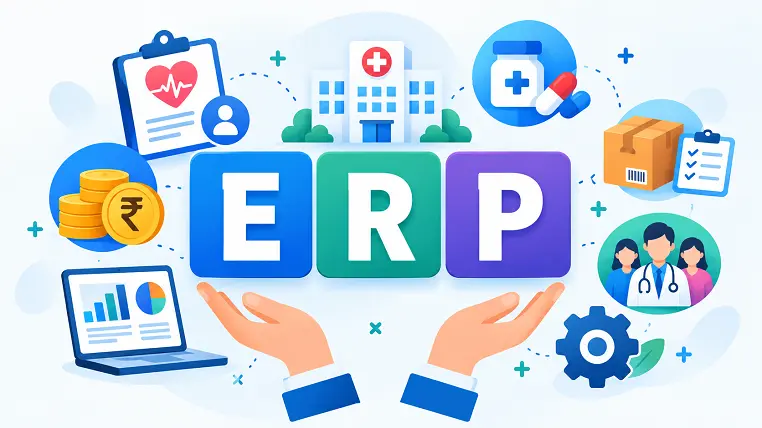
The healthcare industry is built around people, but managing a healthcare organisation also requires accurate information, smooth coordination, and efficient day-to-day operations. Hospitals, clinics, diagnostic centres, pharmacies, and other healthcare organizations deal with a large amount of data every day, including patient information, billing, inventory, purchasing, finance, employee records, and medical support services.Managing all these activities through separate systems or spreadsheets can make operations complicated. This is where ERP for Healthcare Industry can make a meaningful difference.
A healthcare ERP system brings different business functions together on a single platform. It helps organizations connect departments, reduce repetitive work, improve data visibility, and make everyday processes easier to manage.
What Is ERP for Healthcare Industry?
ERP for Healthcare Industry is an integrated enterprise resource planning solution designed to manage the administrative, financial, operational, and resource-related activities of healthcare organizations.Unlike traditional software that focuses on one particular function, an ERP system can connect multiple departments through a centralized database.
Depending on the organization’s requirements, a healthcare ERP solution may manage:
- Finance and accounting
- Procurement and purchasing
- Inventory management
- Pharmacy inventory
- Billing and payments
- Human resources and payroll
- Vendor management
- Asset management
- Patient-related administrative information
- Reporting and analytics
- Department-wise operations
The objective is simple: provide healthcare organizations with a connected system that helps them manage their business operations more efficiently.
Why Healthcare Organizations Need ERP Software
Healthcare organizations often operate through multiple departments, each generating and using different types of information. When these departments work independently, information can become fragmented. For example, the purchase department may maintain supplier information separately, while finance maintains payment records in another system. Similarly, inventory data may not be immediately available to the people responsible for purchasing.
An ERP system helps connect these processes.
Centralized Healthcare Data
A centralized ERP platform allows authorized users to access relevant information from one system. This reduces the need to maintain multiple disconnected records.
Better Coordination Between Departments
Finance, procurement, inventory, HR, administration, and other departments can work with connected information. This can make internal coordination faster and more organized.
Reduced Manual Work
Automating repetitive processes can reduce unnecessary data entry and minimize the chances of errors caused by manual record keeping.
Improved Operational Visibility
Managers can use reports and dashboards to understand business performance, inventory status, expenses, purchases, and other important operational information.
Key Features of Healthcare ERP Systems
Modern Healthcare ERP Systems can be configured according to the size and requirements of an organization. While features differ between ERP solutions, several capabilities are particularly useful for healthcare businesses.
Finance and Accounting Management
Financial management is an important part of every healthcare organization. ERP software can help manage accounting transactions, expenses, receivables, payables, budgets, and financial reports. Having financial and operational information within the same system can also make it easier for management to understand the financial impact of everyday activities.
Inventory and Pharmacy Management
Healthcare organizations need to maintain medicines, consumables, medical supplies, equipment, and other inventory items.
An ERP system can help track:
- Stock availability
- Purchases
- Consumption
- Stock transfers
- Reorder requirements
- Supplier information
- Batch-related information
- Inventory valuation
Better inventory visibility can help organizations avoid unnecessary stock accumulation and reduce the risk of shortages.
Procurement Management
Purchasing involves multiple activities, including purchase requests, supplier selection, purchase orders, receipts, and payments.
Healthcare ERP software can connect these activities and provide a structured procurement workflow.
Human Resource and Payroll Management
Healthcare organizations depend on doctors, nurses, technicians, administrative employees, support staff, and other professionals.
An ERP system can help manage employee records, attendance, leave, payroll, departments, and other HR activities from a centralized platform.
Asset Management
Hospitals and healthcare facilities often use expensive medical equipment and other assets.
ERP software can help organizations maintain asset records, track locations, monitor maintenance schedules, and manage asset-related expenses.
Reporting and Business Analytics
Healthcare management needs accurate information for planning and decision-making.
ERP dashboards and reports can provide visibility into areas such as:
- Revenue
- Expenses
- Inventory
- Procurement
- Department performance
- Employee information
- Vendor transactions
- Asset utilization
How Healthcare ERP Systems Improve Business Operations
The value of Healthcare ERP Systems is not limited to storing information. Their major advantage is connecting different processes.
For example, when a healthcare organization purchases medical supplies, the ERP system can connect the purchase order, goods receipt, inventory update, supplier invoice, and accounting transaction.
This creates a more connected workflow and reduces the need to enter the same information repeatedly.
Faster Access to Information
Employees can find required business information without searching through multiple spreadsheets or disconnected applications.
Improved Accuracy
Centralized data and automated workflows can help reduce duplicate entries and common manual errors.
Better Inventory Control
Real-time or near-real-time inventory information can help organizations monitor stock levels and plan purchases more effectively.
More Efficient Financial Management
Connecting operational transactions with accounting can make financial tracking more organized and transparent.
Stronger Management Reporting
Management can access consolidated information instead of depending entirely on manually prepared reports from individual departments.
Best ERP for Healthcare Industry: What Should You Look For?
The term Best ERP for Healthcare Industry can mean different things for different organizations. A solution that works well for a large hospital may not be suitable for a small clinic or diagnostic center.
Therefore, organizations should focus on business requirements rather than simply choosing software based on the number of features.
Industry-Specific Functionality
The ERP should support the operational requirements of healthcare organizations and be flexible enough to adapt to different workflows.
Scalability
Healthcare businesses can grow over time. The ERP should be capable of supporting additional users, departments, locations, and business processes as the organization expands.
Easy-to-Use Interface
Employees across different departments may have different levels of technical experience. A simple interface can make software adoption easier.
Integration Capabilities
A healthcare ERP may need to exchange information with other systems and applications. Integration capabilities should therefore be considered during the selection process.
Security and Access Control
Healthcare organizations handle sensitive business and patient-related information. Strong user permissions, access controls, authentication, backups, and other security measures are important when selecting an ERP system.
Reporting and Analytics
A good ERP should provide useful reports that help managers monitor operations and identify areas requiring attention.
ERP for Healthcare Industry in India
Healthcare organizations in India operate across a wide range of business models, from independent clinics and diagnostic centers to large hospitals and healthcare groups.An ERP for Healthcare Industry in India should therefore be flexible enough to support different organizational structures and local business requirements.
Organizations may also need features related to accounting, taxation, payroll, procurement, inventory, vendor management, and multi-location operations.The right ERP can help bring these activities together while giving management a centralized view of business operations.
How to Choose the Right Healthcare ERP Software
Selecting ERP software is an important business decision. Instead of choosing a solution only because it has a long list of features, organizations should evaluate how well the software fits their actual processes.
Consider the following questions:
- Does the ERP support our current business processes?
- Can it integrate finance, inventory, procurement, HR, and other departments?
- Can the system scale as our organization grows?
- Is the interface easy for employees to use?
- Does it provide useful management reports?
- Can user permissions be configured according to responsibilities?
- Can the software integrate with existing applications?
- What implementation and support services are available?
- Can the ERP be customized when business requirements change?
- Is the total cost of ownership suitable for the organization?
A proper evaluation based on these questions can help organizations make a more informed ERP selection.
Benefits of Implementing ERP in Healthcare
A properly implemented ERP system can provide several operational benefits.
Improved productivity: Employees spend less time searching for information and performing repetitive data-entry tasks.
Better coordination: Connected departments can work with consistent information.
Improved inventory management: Organizations can monitor stock movement and purchasing requirements more effectively.
Greater financial visibility: Management can connect financial information with operational activities.
Faster reporting: Automated reports reduce dependence on manually consolidated spreadsheets.
Scalable operations: A flexible ERP can support organizational growth and changing business requirements.
Future of Healthcare ERP Systems
Healthcare organizations are becoming increasingly dependent on digital systems for managing their operations. As businesses grow, the need for connected data, automation, analytics, and real-time visibility is also increasing.
Future-focused Healthcare ERP Systems are likely to place greater emphasis on cloud deployment, mobile accessibility, workflow automation, advanced analytics, system integrations, and stronger security controls.The goal is not simply to digitize existing processes. It is to create a connected operational environment where information can move efficiently between departments.
Conclusion
Managing a healthcare organization involves much more than delivering healthcare services. Behind every successful healthcare operation are finance teams, procurement staff, inventory managers, HR professionals, administrators, and other employees working together. Newton ERP is a powerful ERP solution designed to simplify and integrate healthcare business operations. It helps manage finance, inventory, procurement, HR, billing, and reporting through one connected platform.
An ERP for Healthcare Industry can connect these functions through a centralized platform, helping organizations manage their operations with greater visibility and coordination.When evaluating the Best ERP for Healthcare Industry, organizations should focus on their actual requirements, scalability, usability, integration capabilities, security, reporting, and long-term support.The right ERP solution can become an important part of a healthcare organization’s digital infrastructure and help create a more organized, efficient, and connected way of managing business operations.