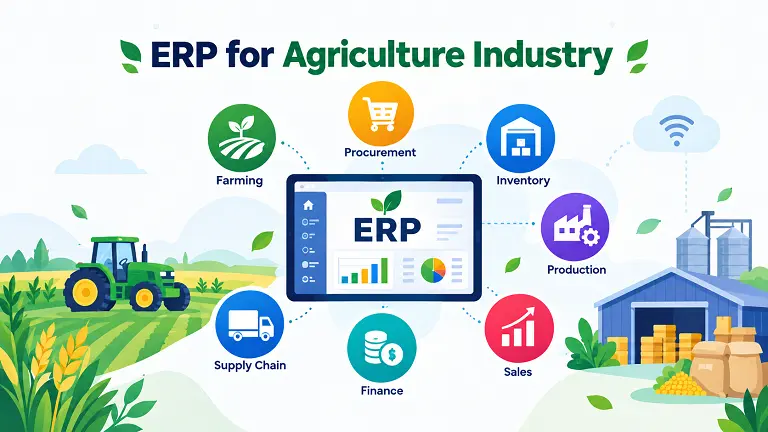
Agriculture is not growing crops and picking crops anymore. Today agriculture businesses are doing all kinds of things, buying supplies, doing inventory, making products, getting the products ready for sale, quality control, selling the products, transporting the products, handling money and clients all at the same time.
As the business gets bigger, handling these tasks with just spreadsheets, handwritten lists, and different software tools can get really tough. Information gets scattered, processes become slower, and management may not have a clear view of what is happening across the business.
This is where ERP for agriculture industry can make a practical difference.
An ERP system brings important business processes together on a single platform, helping agriculture companies improve visibility, reduce manual work, control costs, and make better decisions.
What Is ERP for Agriculture Industry?
ERP for agriculture industry is business management software designed to help agricultural businesses manage their day-to-day operations from one integrated system.
Depending on the business model, an agriculture ERP can manage:
- Farmer and supplier management
- Raw material procurement
- Inventory and warehouse management
- Crop and production planning
- Processing and manufacturing
- Quality management
- Sales and order management
- Purchase management
- Dispatch and logistics
- Accounting and finance
- Customer management
- Reports and business analytics
For businesses involved in agricultural processing, food production, trading, distribution, or agri-inputs, having connected information can make daily operations much easier to manage.
The Common Problems Faced by Agriculture Businesses
Agriculture businesses deal with several challenges that are difficult to manage when information is spread across different systems.
Many businesses still depend heavily on Excel sheets, registers, WhatsApp messages, and manual records. Entering the same information multiple times increases the possibility of errors and consumes valuable employee time.
Difficulty Managing Inventory
Agricultural products and raw materials often have different quality grades, batches, quantities, and storage requirements. Without proper inventory control, businesses can face excess stock, shortages, wastage, or difficulty tracking materials.
Lack of Real-Time Information
Management needs to know what has been purchased, what is available in stock, what has been processed, what has been sold, and what payments are pending.
When information is stored in different places, getting a complete picture can take hours.
Procurement Challenges
Agriculture businesses often purchase raw materials from multiple farmers, suppliers, or vendors. Tracking purchase prices, quantities, supplier details, and incoming materials manually can become complicated as the business expands.
Production and Processing Issues
For agricultural processing businesses, raw materials move through several stages before becoming finished products. Tracking consumption, production output, wastage, and finished goods can be difficult without an integrated system.
Financial and Operational Data Are Separate
When accounts and operational data are maintained separately, it becomes harder to understand the actual cost and profitability of products, orders, customers, or business units.
How ERP for Agriculture Industry Solves These Problems
An integrated ERP system connects different departments and processes so that information can move through the business without unnecessary duplication.
Centralized Business Information
Instead of maintaining separate records for purchasing, inventory, sales, production, and finance, an ERP provides a centralized system.
Authorized users can access the information they need according to their roles.
Better Inventory Control
An ERP can help businesses monitor stock levels, batches, movements, receipts, consumption, and dispatches.
This gives management better visibility into available inventory and helps reduce avoidable stock-related problems.
Streamlined Procurement
Agriculture businesses can manage purchase orders, suppliers, receipts, pricing, and procurement-related information in one system.
This can make the procurement process more organized and easier to monitor.
Improved Production and Processing Management
Businesses involved in agricultural processing can use ERP to plan production and monitor material consumption, output, wastage, and finished goods.
This creates better visibility throughout the processing cycle.
Faster Financial Management
When operational transactions are connected with finance, accounting teams can reduce repetitive data entry and get better visibility into business transactions.
Management can also use reports to understand revenues, expenses, outstanding payments, and other financial information.
Better Reporting and Decision-Making
Instead of waiting for multiple departments to prepare separate reports, management can access consolidated information from the ERP system.
This supports faster and more informed business decisions.
Key Features of ERP for Agriculture Industry
Not every agriculture business has the same requirements. However, an ERP solution should ideally support the core processes that are important to the business.
Important capabilities may include:
- Procurement management
- Supplier management
- Inventory management
- Warehouse management
- Batch and lot tracking
- Production management
- Quality management
- Sales management
- Purchase management
- Accounting and finance
- Order management
- Dispatch management
- Customer management
- Business reports and dashboards
- Multi-location management
The right features will depend on whether the company is involved in farming, agricultural trading, food processing, agri-inputs, distribution, or another part of the agricultural value chain.
Why Agriculture Businesses Need ERP Software
A small agriculture business may initially manage operations through spreadsheets and manual processes. But as the number of suppliers, customers, products, warehouses, employees, and transactions increases, those methods can become difficult to maintain.
ERP helps create a structured way of managing the business.The biggest benefit is not simply replacing Excel. The real value comes from connecting business processes.
For example, a purchase transaction can update inventory, while sales and dispatch information can flow into financial records. This reduces the need to repeatedly enter the same information in different systems.
Why Choose Newton ERP for Agriculture Industry?
Newton ERP can help agriculture and agri-business companies bring their key business processes together through an integrated ERP platform.
Instead of managing different departments independently, businesses can use one system to connect important activities such as purchasing, inventory, sales, production, finance, and reporting.
One Platform for Multiple Business Processes
Newton ERP can help businesses manage their operations through an integrated platform, reducing dependence on disconnected tools and manual records.
Better Visibility Across Operations
Management can get a clearer view of business activities and use centralized information for monitoring and decision-making.
Suitable for Growing Businesses
As an agriculture business expands into additional products, locations, suppliers, customers, or operations, having a structured ERP system can make business management more scalable.
Improved Process Control
Standardized workflows can help organizations create greater consistency across procurement, inventory, sales, production, and other business activities.
Data-Driven Business Decisions
Reports and dashboards can provide useful information about business performance, inventory, sales, purchases, and financial activities. This allows management to spend less time collecting information and more time using it.
ERP for Agriculture Industry: From Manual Operations to Digital Management
The agriculture sector is becoming increasingly connected and data-driven. Businesses need better visibility over their supply chains, inventory, costs, production, and customers.
An ERP system can provide the digital foundation needed to manage these processes in a more organized way.
Whether you are running an agricultural trading company, food-processing business, agri-input business, or another agriculture-related enterprise, the right ERP can help connect operations and provide a clearer view of the business.
Conclusion
Agriculture businesses operate in an environment where cost control, inventory management, procurement, production, and timely delivery are important to everyday success.Managing these activities through disconnected spreadsheets and manual processes can become increasingly difficult as the business grows.
ERP for agriculture industry provides a way to bring these processes together, improve information visibility, reduce repetitive work, and support better business management. With an integrated solution such as Newton ERP, agriculture businesses can build a more organized digital workflow and create a stronger foundation for future growth.