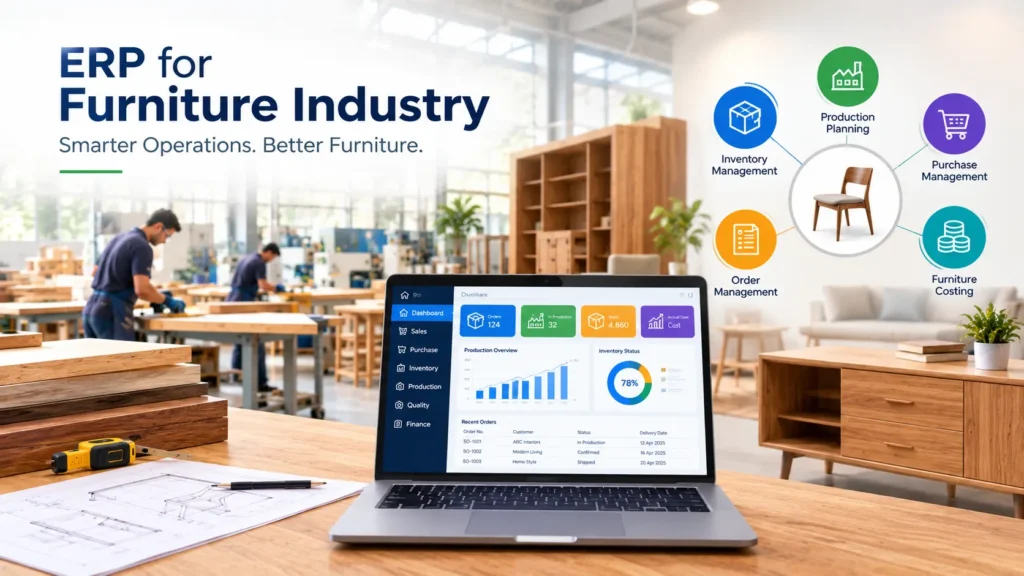
The furniture industry is changing quickly. Customers expect better designs, faster delivery, competitive prices, and consistent quality. At the same time, furniture manufacturers have to manage raw materials, production schedules, inventory, suppliers, workers, orders, and finances—all at once.
Managing all these activities through spreadsheets or separate software can become difficult as the business grows. This is where an ERP system can make a real difference.
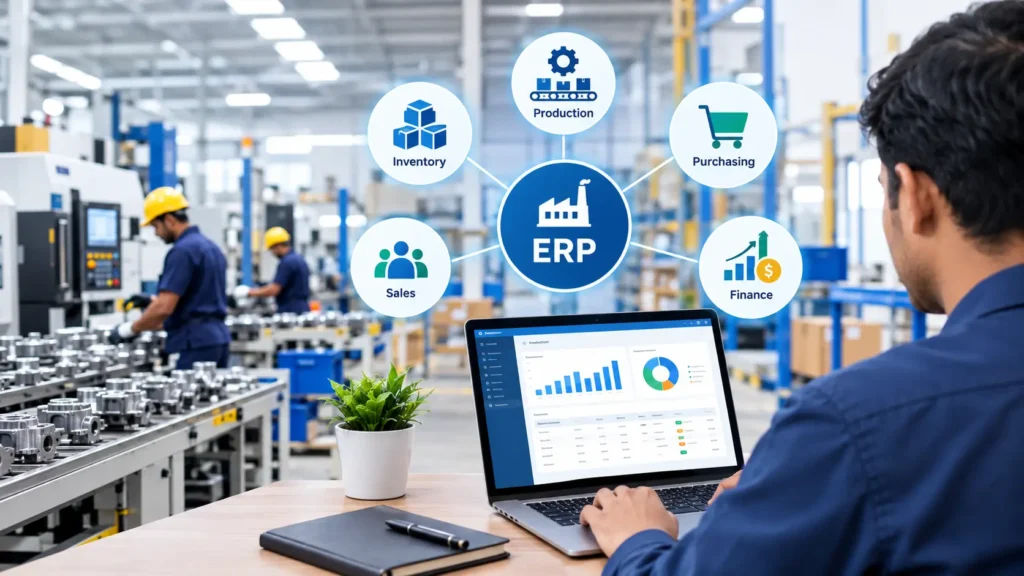
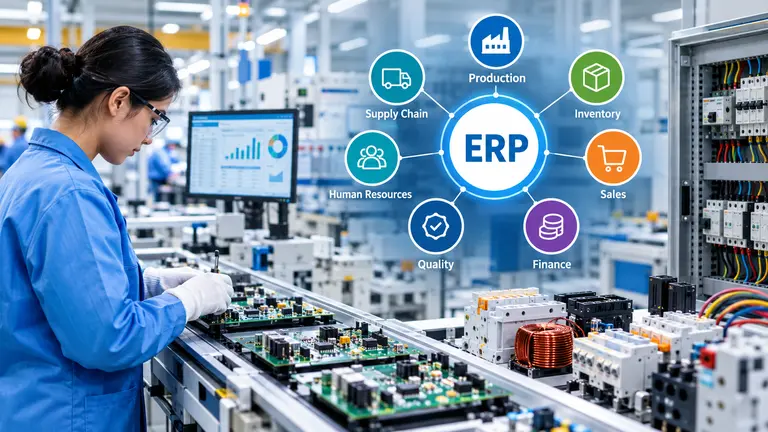
An ERP system brings important business processes together in one place. It helps furniture manufacturers plan production, control inventory, manage orders, track costs, and make better business decisions using real-time information.
ERP for Furniture Industry
An ERP for furniture industry is designed to manage the specific requirements of furniture manufacturers, wholesalers, and distributors. Unlike basic accounting or inventory software, an ERP solution can connect different departments and provide a complete view of business operations.
Furniture manufacturing often involves multiple materials and processes. A single product may require wood, plywood, MDF, hardware, fabric, foam, glass, polish, paint, adhesives, and other components. Managing these materials accurately is essential for controlling production costs.
With an ERP system, businesses can manage:
- Raw material purchasing
- Inventory and stock levels
- Product designs and specifications
- Bills of materials (BOM)
- Production planning
- Work orders
- Sales orders
- Purchase orders
- Quality control
- Vendor management
- Customer management
- Costing
- Invoicing and accounting
- Dispatch and delivery
- Business reports
By connecting these functions, an ERP solution helps reduce manual work and gives management better visibility into daily operations.
Why Furniture Manufacturers Need ERP Software
Furniture manufacturing is not simply about producing a product and selling it. There are many steps between receiving an order and delivering the finished furniture.
For example, a manufacturer may receive an order for 100 dining tables. Before production begins, the company needs to check the required materials, available stock, production capacity, labour requirements, machine availability, and delivery schedule.Without an integrated system, information can become scattered across spreadsheets, emails, registers, and different applications.
An ERP system provides a centralized platform where departments can work with the same information.
This can help businesses:
- Reduce data duplication
- Improve inventory visibility
- Minimize production delays
- Track manufacturing costs
- Improve order management
- Reduce material wastage
- Monitor production progress
- Improve coordination between departments
- Make faster business decisions
ERP Software for Furniture Industry
ERP for furniture industry helps manufacturers manage their complete business process from procurement to production and sales.
One of the biggest advantages is better coordination between different departments. When the sales team receives an order, the information can flow into production planning. The purchase team can identify material requirements, while inventory teams can check available stock.
This connected approach reduces the need to enter the same information multiple times.
Inventory Management
Furniture companies often maintain a large variety of materials and components. Keeping track of every item manually can be challenging.
ERP software can provide real-time visibility into:
- Available stock
- Reserved stock
- Incoming materials
- Minimum stock levels
- Material consumption
- Finished goods
- Slow-moving inventory
This helps businesses maintain the right level of inventory without unnecessarily tying up money in excess stock.
Bill of Materials Management
A furniture product can contain many components. For example, a modular wardrobe may require panels, hinges, handles, screws, rails, laminate, adhesive, and other materials.
A Bill of Materials (BOM) defines what materials and components are required to manufacture a particular product.ERP software allows manufacturers to create and maintain BOMs so that production teams know exactly what is required for each product.
Production Planning
Production planning becomes easier when managers have visibility into orders, inventory, machines, labour, and production capacity.An ERP system can help manufacturers plan production according to customer requirements and available resources.
This can help reduce idle time and improve the utilization of production resources.
Purchase Management
The purchasing department needs to make sure materials are available when production requires them.
ERP software can help track:
- Purchase requisitions
- Purchase orders
- Supplier details
- Material requirements
- Supplier quotations
- Purchase prices
- Delivery schedules
- Pending orders
This makes procurement more organized and helps businesses maintain better relationships with suppliers.
Furniture Costing
Accurate product costing is important for maintaining healthy profit margins.
Furniture manufacturing costs may include:
- Raw materials
- Labour
- Machine costs
- Electricity
- Finishing
- Packaging
- Transportation
- Other production expenses
An ERP system can bring these costs together to provide better visibility into the actual cost of manufacturing a product.
ERP System for Furniture Manufacturing
An ERP for furniture manufacturing connects manufacturing activities with inventory, purchasing, sales, finance, and other business operations.
Furniture manufacturers can use ERP to manage the complete production cycle.
From Customer Order to Production
When a customer places an order, the ERP system can capture the order details and connect them with production planning.
The system can help determine:
- What needs to be manufactured?
- What materials are required?
- What materials are already available?
- What needs to be purchased?
- What production capacity is available?
- When can production be completed?
- When should the product be dispatched?
Having this information in one system makes it easier for managers to plan and coordinate operations.
Work Order Management
Work orders provide production teams with clear instructions about what needs to be manufactured.An ERP system can help track work orders from the beginning of production through completion.
Managers can monitor production status and identify delays before they become bigger problems.
Quality Management
Furniture quality can have a major impact on customer satisfaction and brand reputation.
ERP software can support quality checks at different stages of manufacturing, such as:
- Incoming material inspection
- In-process quality checks
- Final product inspection
- Defect tracking
- Rework management
This allows manufacturers to identify recurring quality issues and take corrective action.
Managing Custom Furniture Orders
Many furniture businesses manufacture customized products based on customer requirements.Customization can involve different dimensions, materials, colours, finishes, fabrics, designs, and configurations.Managing these variations manually can be complicated.
An ERP system can help store product specifications and order details so that sales, production, purchasing, and dispatch teams work with the same information.
Benefits of ERP for Furniture Manufacturers
Implementing an ERP solution can provide several operational benefits.
Better Inventory Control
Manufacturers can monitor raw materials and finished products more effectively. This helps reduce both stock shortages and unnecessary inventory.
Reduced Material Wastage
Better planning and material tracking can help businesses identify material consumption and reduce avoidable wastage.
Improved Production Efficiency
Production managers can get better visibility into work orders, schedules, resources, and production progress.
Faster Order Processing
Sales orders can move more efficiently from order entry to production and dispatch.
Better Cost Control
Manufacturers can monitor production costs and compare actual costs with planned or estimated costs.
Improved Decision-Making
Management can use reports and dashboards to understand sales, inventory, production, purchasing, and financial performance.
Better Customer Service
When order and production information is available in one system, businesses can provide customers with more accurate updates about order status and delivery schedules.
How to Choose the Right ERP Software for Furniture Industry
Every furniture business has different requirements. A small furniture manufacturer may need basic production and inventory features, while a large manufacturer may require advanced planning, multi-location inventory, financial management, and detailed production controls.
Before selecting ERP software, businesses should consider:
- Industry-specific functionality
- Ease of use
- Production management capabilities
- Inventory management
- BOM management
- Purchase management
- Sales management
- Accounting integration
- Reporting and dashboards
- Scalability
- Mobile accessibility
- Integration capabilities
- Vendor support
- Implementation requirements
It is also important to involve employees who will actually use the system. Their feedback can help identify practical requirements that may otherwise be overlooked.
ERP Implementation: What Furniture Companies Should Expect
ERP implementation is not just about installing software. It involves understanding existing business processes and deciding how those processes should work within the new system.
A typical implementation may include:
- Understanding business requirements
- Mapping existing processes
- Configuring the ERP system
- Migrating required data
- Testing workflows
- Training employees
- Going live
- Providing ongoing support
Proper employee training is particularly important. Even a powerful ERP system will not deliver its full value if employees do not understand how to use it correctly.
The Future of ERP in the Furniture Industry
The furniture industry is becoming increasingly data-driven. Manufacturers are looking for better ways to manage costs, production, inventory, customer expectations, and delivery schedules.Modern ERP systems are also becoming more connected with technologies such as cloud computing, business intelligence, automation, mobile applications, and analytics.
For furniture manufacturers, this means ERP is becoming more than a back-office management tool. It can become a central platform for managing and improving business operations.
Newton ERP helps furniture manufacturers manage their complete business operations from one integrated platform. From raw material and inventory management to production planning, purchasing, sales, costing, and order tracking, Newton ERP brings everything together in one place. It helps furniture businesses reduce manual work, improve production visibility, control costs, and make day-to-day operations more efficient.
Conclusion
Furniture manufacturing involves many interconnected activities, from purchasing raw materials to designing products, planning production, managing inventory, controlling quality, processing orders, and delivering finished products.An ERP for furniture industry can bring these processes together and provide a single source of business information.The right ERP software for furniture industry can help manufacturers improve inventory control, production planning, costing, purchasing, and order management.
At the same time, an ERP system for furniture manufacturing can provide better visibility across the entire manufacturing cycle, helping businesses manage day-to-day operations more efficiently and make informed decisions.
For furniture companies planning to grow, improve operational control, and reduce manual processes, choosing an ERP system that fits their specific manufacturing requirements can be an important step toward building a more organized and scalable business.