The banking industry handles a huge volume of financial transactions, customer information, compliance requirements, employee activities, and internal processes every day. Managing all these operations manually or through disconnected systems can lead to delays, errors, higher costs, and difficulty in maintaining accurate information.
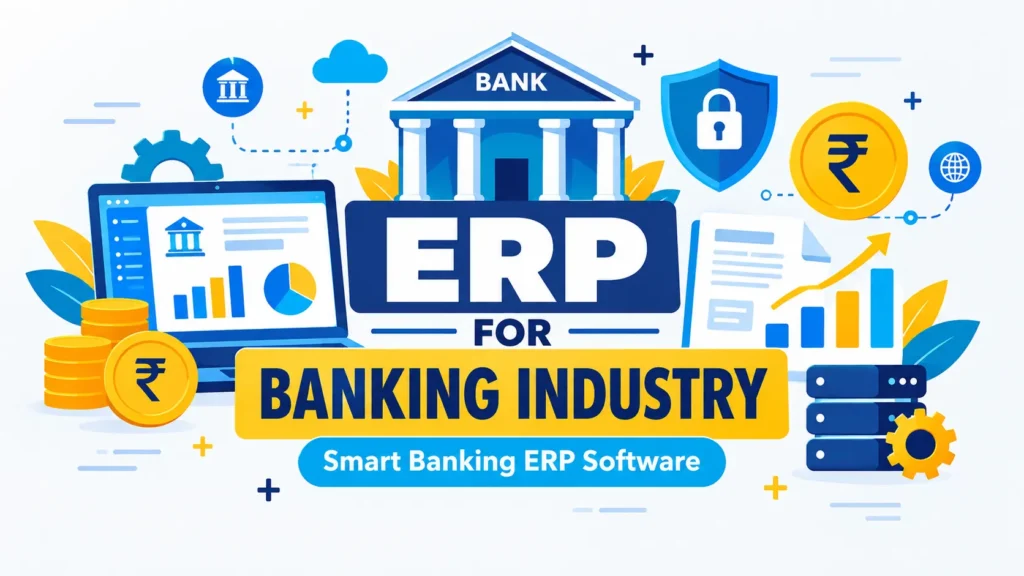
ERP for the banking industry provides a centralized platform that brings important business processes together. From finance and accounting to human resources, procurement, reporting, and compliance, an ERP system can help banks manage their internal operations more efficiently.
What Is ERP for the Banking Industry?
ERP for banking industry refers to enterprise resource planning software designed to manage the internal business and administrative functions of banks and financial organizations through a unified system.Unlike traditional software where different departments may maintain separate databases, an ERP system connects information across departments. This gives management a clearer view of operations and helps employees work with more consistent and updated information.
A banking ERP solution can support areas such as:
- Financial accounting and reporting
- Budget and expense management
- Human resource management
- Payroll
- Procurement
- Asset management
- Vendor management
- Compliance-related reporting
- Business intelligence and analytics
- Document and workflow management
The exact functionality depends on the ERP platform and the bank’s operational requirements.
Why Do Banks Need ERP Software?
Banks operate in an environment where accuracy, security, transparency, and timely reporting are extremely important. Even a small administrative error can create unnecessary operational work.An ERP system for banking helps organizations reduce dependency on spreadsheets and disconnected applications by creating a centralized environment for internal operations.
Better Financial Management
ERP software can bring accounting, budgeting, expenses, and financial reporting into one system. Finance teams can access organized financial information without repeatedly collecting data from different departments.
This can make financial planning and reporting more efficient.
Centralized Data Management
When information is spread across multiple systems, finding the latest and most accurate data can become difficult.
Banking ERP software provides a centralized source of business information, allowing authorized users to access relevant data according to their roles.
Improved Operational Efficiency
Automating repetitive administrative tasks can save employee time. Instead of spending hours entering the same information into multiple systems, employees can focus on activities that require greater attention and decision-making.
Key Features of Banking ERP Software
The best ERP software for banking should be flexible enough to support different departments while maintaining strong controls over data and user access.
1. Finance and Accounting Management
Financial management is one of the most important components of an ERP system.
A banking ERP solution can help manage:
- General ledger
- Accounts payable
- Accounts receivable
- Expense management
- Budgeting
- Financial statements
- Cost tracking
- Management reporting
Having financial information in one platform can help finance teams improve visibility and reduce manual reconciliation work.
2. Human Resource and Payroll Management
Banks employ people across multiple branches, departments, and functions. Managing employee information manually can become complicated as an organization grows.An ERP system can help HR teams manage employee records, attendance, leave, payroll, recruitment, and other HR processes from a centralized platform.
3. Procurement and Vendor Management
Banks regularly purchase technology, office equipment, professional services, security solutions, and other resources.
ERP software can organize the procurement process from purchase requests and approvals to purchase orders, vendor records, and payment processing.
4. Asset Management
Banks manage a wide range of physical and digital assets.
ERP software can help organizations maintain records of assets, track their locations, monitor depreciation, and manage maintenance activities.
5. Reporting and Business Analytics
Decision-makers need reliable information to understand operational performance.With ERP-based reporting and dashboards, management can analyze expenses, departmental performance, budgets, procurement activity, employee information, and other business indicators.
This supports more informed decision-making.
Benefits of ERP for Banking Industry
Implementing an ERP for the banking industry can provide several operational benefits.
Reduced Manual Work
Automating repetitive processes reduces the amount of manual data entry required from employees. This can also reduce the possibility of errors caused by repeated information handling.
Faster Reporting
When data is available through a centralized system, teams can generate reports more quickly instead of collecting information manually from multiple departments.
Improved Transparency
An ERP system can provide better visibility into transactions, approvals, expenses, procurement, and other internal activities.
Role-based access and workflow controls can also help organizations establish clearer responsibilities.
Better Cost Control
ERP software can provide greater visibility into expenses, budgets, procurement, and departmental costs. Management can use this information to identify unnecessary spending and improve resource allocation.
Scalable Operations
As banks expand their operations, managing increasing volumes of information and employees can become challenging.A scalable ERP platform can support organizational growth by providing standardized processes and centralized information management.
How ERP Supports Banking Digital Transformation
Digital transformation in banking is not limited to mobile banking or online transactions. Internal business operations also need to become more connected and efficient.
This is where ERP software for banking industry can play an important role.
By connecting finance, HR, procurement, assets, reporting, and other internal processes, ERP creates a foundation for better data visibility and process automation.
When ERP is combined with technologies such as analytics, cloud computing, workflow automation, and AI-enabled tools, banks can further improve operational efficiency and decision-making.
ERP for Banking Industry: Security and Access Control
Security is a critical consideration when selecting an ERP solution for a financial organization.
A suitable banking ERP system should provide features such as:
- Role-based user access
- Permission management
- Approval workflows
- Activity tracking
- Audit trails
- Data backup
- Secure authentication
- Controlled access to sensitive information
Banks should also evaluate the ERP provider’s security practices, infrastructure, integration capabilities, and compliance requirements before implementation.
How to Choose the Best ERP Software for Banking
Choosing the best ERP software for banking should begin with understanding the organization’s actual operational requirements.
Before selecting a solution, banks should consider:
Business requirements: Identify which departments and processes need ERP support.
Integration capabilities: Check whether the ERP can integrate with existing banking applications and systems.
Security: Evaluate access controls, audit capabilities, data protection, and security architecture.
Scalability: Make sure the system can support future organizational growth.
Customization: Determine whether workflows and reports can be configured according to business requirements.
Reporting: Look for flexible dashboards and reporting capabilities that can support management decisions.
Implementation support: Consider training, migration, customization, technical support, and post-implementation services.
The cheapest ERP solution is not always the best option. The right solution should provide a balance between functionality, security, scalability, usability, and long-term value.
Common Challenges in ERP Implementation for Banks
ERP implementation can significantly improve operations, but it needs proper planning.
Some common challenges include:
- Migration of existing data
- Integration with legacy systems
- Employee training
- Process standardization
- Change management
- Customization requirements
- Data security
- Implementation costs
A phased implementation approach can help organizations manage these challenges more effectively.
Why Newton ERP Can Be Considered for Banking Operations
Newton ERP provides an integrated approach to managing business operations through centralized ERP functionality. For organizations looking to streamline finance, HR, procurement, reporting, and other administrative processes, an ERP platform can provide a structured foundation for digital operations.
Before implementation, banking organizations should map their current processes, identify operational gaps, and determine which ERP modules and integrations are required.
Conclusion
The banking industry is becoming increasingly technology-driven, and efficient internal operations are essential for sustainable growth. ERP for the banking industry can help organizations connect departments, automate routine processes, improve financial visibility, and make business information easier to manage.Rather than viewing ERP simply as accounting or administrative software, banks can consider it as a centralized operational platform that supports better coordination across the organization.
For banks planning their next stage of digital transformation, selecting the right banking ERP software can be an important step toward creating more efficient, transparent, and scalable business operations.