Construction companies manage much more than bricks, concrete, labour and equipment. Every project involves budgets, materials, vendors, subcontractors, employees, deadlines, client billing and constant coordination between the office and the site.When these activities are managed through spreadsheets, emails and disconnected software, it becomes difficult to know the actual status of a project. This is where ERP Software for the construction industry can make a significant difference.
A construction ERP brings project management, procurement, inventory, accounting, billing, labour, subcontractor management and reporting together in one system. Instead of maintaining information across multiple platforms, construction businesses can work with a centralised flow of information.
What Is ERP Software for the Construction Industry?
ERP Software for the Construction Industry is a business management solution designed to connect the different activities involved in construction projects.Unlike a basic accounting system, construction ERP focuses on the complete project lifecycle—from estimation and tendering to procurement, execution, billing and project completion.
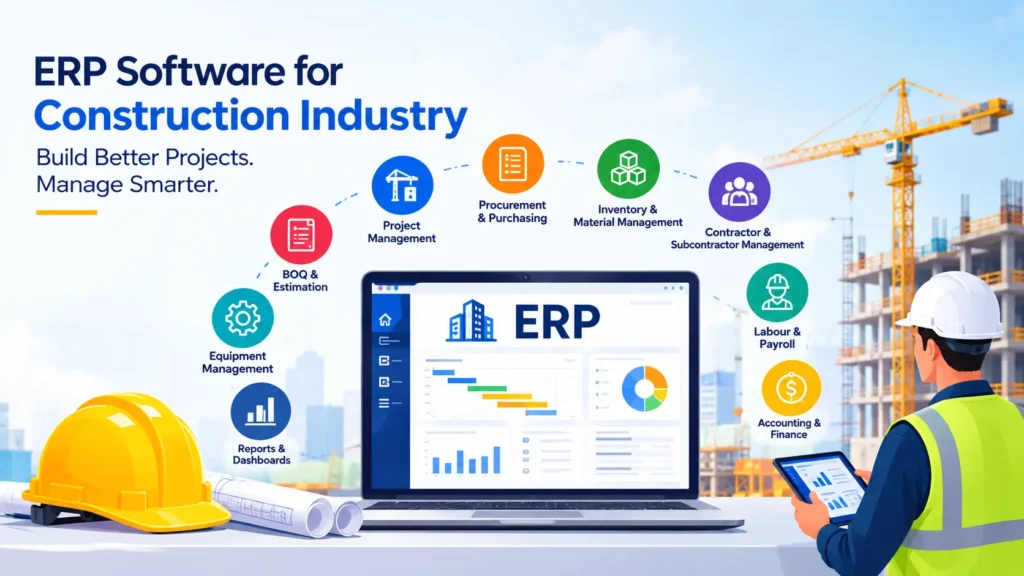
A typical construction ERP can connect:
- Project planning and management
- BOQ and estimation
- Budget and cost control
- Procurement and purchasing
- Material and inventory management
- Contractor and subcontractor management
- Labour and payroll
- Client billing
- Accounting and finance
- Equipment management
- Document management
- Reports and dashboards
The biggest advantage is that information from these functions can be connected instead of being maintained separately.
Construction ERP Software: Why Do Construction Companies Need It?
Construction projects often involve multiple teams, suppliers, sites and financial transactions. Even a small communication gap can result in material shortages, delayed approvals or unexpected costs.Construction ERP Software helps bring these activities into one organised workflow.For example, a site team can raise a material requirement, the purchase department can process the request, the store team can record the received material and the finance team can track the related financial transaction.This connected approach can give management better visibility into what is happening across projects.
Industry-focused ERP systems commonly connect estimating, project costing, procurement, subcontracting, billing and financial control around individual projects.
Key Features of ERP Software for Construction Industry
The right ERP should not simply provide a collection of software modules. The important part is how those modules work together.
1. Project Management
Construction ERP can help managers plan projects, define milestones, assign responsibilities and monitor progress.
Management can track:
- Project timelines
- Activities and milestones
- Project budgets
- Work progress
- Resource allocation
- Project expenses
- Completion status
This gives project managers a central place to monitor important information.
2. BOQ and Estimation Management
The Bill of Quantities (BOQ) is an important part of construction planning.A construction ERP can help businesses create and manage BOQs, estimate material requirements and compare planned costs with actual expenses.
This can help management identify cost variations earlier instead of discovering them after project completion.
3. Procurement Management
Construction companies purchase large quantities of materials from different suppliers.A construction ERP can streamline the procurement process from requirement generation to purchase order and receipt.
Common workflows include:
Material Requirement → Approval → Vendor Quotation → Purchase Order → Material Receipt → Invoice → Payment
Connecting these steps helps reduce duplicate data entry and provides better purchasing visibility.
4. Inventory and Material Management
Material management becomes particularly challenging when a company operates several construction sites.
Construction ERP Software can provide site-wise inventory visibility and help track:
- Cement
- Steel
- Bricks
- Sand
- Aggregates
- Electrical materials
- Plumbing materials
- Other project-specific items
Businesses can monitor material receipts, issues, transfers and consumption while keeping project requirements in view.
5. Contractor and Subcontractor Management
Many construction businesses depend on contractors and subcontractors for specialised work.
ERP can help manage:
- Contractor details
- Work orders
- Contract values
- Work progress
- Measurements
- Contractor bills
- Payments
- Retention
- Performance information
This creates a more organised record of subcontractor activities.
6. Construction Accounting and Finance
Financial management is at the centre of every construction business.A construction ERP can connect project transactions with accounting information so management can better understand revenue, expenses, receivables, payables and profitability.
Project-based financial visibility is one of the key differences between construction-focused ERP and basic accounting software.
7. Labour and Payroll Management
Construction companies may have employees, contract workers and site labour working across different locations.
ERP can help manage:
- Attendance
- Labour allocation
- Wages
- Payroll
- Employee records
- Site-wise workforce information
This can reduce manual calculations and make workforce information easier to access.
8. Equipment and Machinery Management
Construction equipment represents a major investment.
ERP can help companies maintain information about:
- Equipment allocation
- Usage
- Maintenance
- Fuel
- Operating costs
- Service schedules
This can help companies improve equipment utilisation and reduce avoidable downtime.
9. Client Billing and Payment Tracking
Construction billing is often connected to project progress and contractual milestones.
An ERP can help businesses manage:
- Project billing
- Milestone billing
- Progress billing
- Invoices
- Receivables
- Payment status
- Outstanding amounts
A centralised billing process can also help finance and project teams work with the same information.
10. Real-Time Reports and Dashboards
Construction management requires timely information.
Instead of waiting for manually prepared reports, ERP dashboards can provide visibility into areas such as:
- Budget vs. actual cost
- Project profitability
- Procurement status
- Material consumption
- Outstanding payments
- Vendor balances
- Project progress
- Cash flow
This allows managers to make decisions using current business information.
Benefits of Construction ERP Software
Implementing Construction ERP Software can provide benefits across the organisation.
Better Project Cost Control
Managers can compare estimated budgets with actual expenses and identify cost variations.
Improved Productivity
Automating repetitive activities can reduce the amount of manual data entry and follow-up required from employees.
Centralised Information
Project, finance, procurement and inventory information can be maintained within a connected system rather than scattered across spreadsheets and applications.
Better Collaboration
Office teams, project managers, purchase teams, finance departments and site teams can work from connected information.
Improved Material Control
Site-wise material tracking can help companies understand consumption, transfers and stock availability.
Faster Decision-Making
Real-time dashboards can give management quicker access to important business information.
Better Financial Visibility
Project-related income and expenses can be analysed more effectively when financial information is connected to project operations.
ERP Software for Construction Industry in India
For Indian construction companies, ERP selection should go beyond basic project management.Businesses should evaluate whether the system supports their specific financial, taxation, billing and operational requirements.
Depending on the organisation, important capabilities may include:
- GST-ready invoicing
- TDS management
- E-invoicing
- Project-wise accounting
- BOQ management
- RA billing
- Contractor billing
- Site-wise inventory
- Labour management
- Multi-project management
- Purchase management
- Financial reporting
Indian construction ERP solutions commonly position BOQ, procurement, inventory, subcontractor billing, GST and project costing as important industry-specific capabilities.
Construction ERP Software vs. Traditional Software
Many construction companies use separate tools for accounting, inventory, project management and spreadsheets.The problem is that these systems may not communicate effectively with each other.
For example:
Traditional approach
Site → Spreadsheet → Email → Purchase Team → Accounting Software → Management Report
ERP approach
Site → Construction ERP → Procurement → Inventory → Project Costing → Finance → Management Dashboard
The second approach creates a connected flow of information.
The goal is not simply to replace every existing application. The goal is to create a reliable system where critical business information can move between departments without unnecessary duplication.
How to Choose the Right Construction ERP Software
Choosing an ERP is a long-term business decision. Companies should evaluate the software based on their actual construction processes rather than selecting a system only because it has a long feature list.
Understand Your Current Processes
Before choosing software, document how your company currently handles:
- Project planning
- Estimation
- Procurement
- Inventory
- Contractors
- Billing
- Accounting
- Payroll
- Reporting
This helps identify the areas where ERP can create the most value.
Check Industry-Specific Features
Ask whether the system genuinely supports construction workflows such as BOQ, project costing, site inventory, contractor billing and project-based reporting.
Consider Ease of Use
A powerful ERP will not deliver its full value if employees and site teams find it difficult to use.Mobile access and simple workflows can be particularly useful for employees working outside the main office.
Evaluate Scalability
Your ERP should be able to support business growth.
Consider whether the system can handle:
- More projects
- More users
- Multiple locations
- More vendors
- Larger transaction volumes
- Additional business divisions
Check Integration Capabilities
If your business already uses accounting, payroll, CRM or other applications, check whether the ERP can integrate with them.
Evaluate Support and Implementation
ERP implementation involves more than installing software.Training, data migration, process configuration, user adoption and post-implementation support should also be considered.
Who Can Use Construction ERP Software?
Construction ERP Software can be useful for different types of organisations, including:
- Building contractors
- Infrastructure companies
- Civil contractors
- Real estate developers
- Commercial construction companies
- Residential construction companies
- Engineering and construction companies
- EPC companies
- Interior and fit-out contractors
- Multi-project construction businesses
The exact ERP configuration should depend on the company’s size, project complexity and business processes.
How Construction ERP Improves Project Profitability
Profitability does not depend only on winning projects. Construction companies also need to control costs during execution.
ERP can help management connect:
Estimated Cost → Purchase Cost → Material Consumption → Labour Cost → Contractor Cost → Actual Project Cost → Project Revenue → Profitability
This creates a clearer picture of where money is being spent.
For example, if material costs are increasing on a particular project, management can identify the variation earlier and investigate the reason instead of waiting until the project is completed.
The Future of Construction ERP Software
Construction businesses are increasingly looking for connected digital systems instead of isolated applications.
Modern construction platforms are also beginning to incorporate automation, mobile workflows, analytics and AI-assisted decision support.The direction is clear: construction management is becoming increasingly data-driven.However, technology should support practical business processes rather than simply adding more features. A successful ERP implementation depends on accurate data, employee adoption, clearly defined workflows and effective implementation.
Conclusion
Construction companies need more than software for accounting or task management. They need a connected system that understands how projects, materials, people, contractors and money work together.ERP Software for Construction Industry can provide that connection by bringing essential business processes into one platform.The right Construction ERP Software can help businesses improve project visibility, control costs, manage resources, streamline procurement and make faster decisions.
Newton ERP helps construction businesses manage projects, procurement, inventory, labour, contractors, billing, and accounting from one integrated platform.It provides real-time project visibility, improves cost control, reduces manual work, and helps construction companies make faster, smarter decisions.
Ultimately, the best ERP is not the one with the longest feature list. It is the one that fits your construction processes, is easy for your teams to use and provides reliable information when management needs it.