The selection of an effective ERP system is among the top business decisions a business can make in the year 2026. Businesses now desire to have enhanced control in finance, sales, inventory, and day-to-day activities.
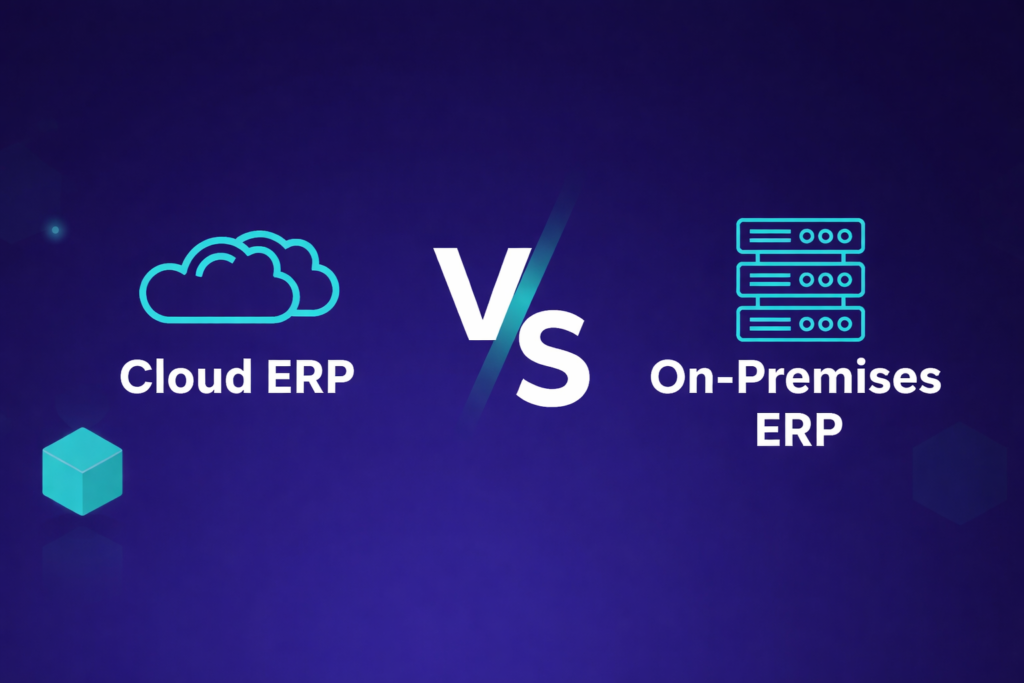
This is how the Cloud ERP vs On-Premise debate is more topical than ever. Both are available to assist businesses in operating smoothly, but in very different ways.
This blog describes the distinction in simple terms such that the users who are non-technical can clearly understand what ERP system fits their business requirements.
What Is Cloud ERP and What Is On-Premise ERP?
Cloud ERP is a software that operates online. The system is hosted by the ERP provider and is accessed by the user through a browser in the computers of the provider. Apple facilities charge a monthly or annual subscription, and the management handles security, updates, and maintenance.
ERP systems installed on-premises are done on company-owned servers. The hardware, software updates, security, and backups are handled by the internal IT team of the business. These systems typically demand a single payment of a license fee and a payment of maintenance fees annually.
Cloud ERP vs On-Premise ERP: Quick Comparison
| Feature | Cloud ERP | On-Premise ERP Systems |
| Installation | Runs on the internet | Installed on company servers |
| Initial Cost | Low starting cost | High upfront investment |
| Payment Model | Monthly or yearly subscription | One-time license plus maintenance |
| Deployment Time | Fast setup, usually weeks | Slow setup, can take months |
| Scalability | Easy to scale as business grows | Scaling needs new hardware |
| Maintenance | Managed by an ERP provider | Managed by the internal IT team |
| Updates | Automatic and regular | Manual and time-consuming |
| Security | Strong vendor-managed security | Full control by the company |
| Best For | Small and mid-sized businesses | Large enterprises with strict control needs |
Cost Comparison and Budget Planning
One of the key considerations in on-premises ERP comparison is the cost. Cloud ERP does not involve a high initial investment. Businesses will not need to purchase servers or have a big IT department. The subscription model renders the costs predictable and manageable.
On-premises ERP systems are expensive. The companies are forced to invest in hardware, licenses, power backup, and qualified IT personnel. As time goes by, the upgrade and maintenance fees add to the cost.
For businesses looking to reduce financial risk and manage cash flow better, Cloud ERP is usually the smarter choice.
Deployment Speed and Ease of Use
ERP systems on the cloud can be installed within a short time. Most businesses are established in a matter of a few weeks. Updates are automatic, and users are constantly working on the most current version. On-prem EMR systems take more time to implement.
The process of installing, testing, and customizing hardware may take months. Updates also have to be planned, and downtime is required. Cloud ERP has obvious benefits in a rapidly developing business setup.
Scalability and Business Growth
Cloud ERP expands as your business expands. New users, branches, or modules are easy to add. This is suitable for startups and growing businesses.
ERP systems installed on-premises are more difficult to scale. Capacity addition will usually require the purchase of new hardware and licenses, which raises the cost and time. Cloud ERP is more advantageous to businesses that seek to expand within a short period of time.
Security and Data Control
Most of the businesses feel that the on-premises ERP is less risky as the data remains in the company. Although this will offer control, it will also leave complete security responsibility on the business.
Cloud ERP vendors put a lot of effort into preparing data protection, backup, and compliance. Cloud security is trusted and dependable in 2026 for most industries. On-premise ERP systems can be favored by businesses that have extremely strict regulatory needs.
Customization and Integration Capabilities
The on-premises ERP systems can be heavily customized that be utilized in complex processes. Nevertheless, customization adds to the maintenance and upgrade, and update difficulties.
Flexibility in forms of modules and integrations is also provided in modern Cloud ERP platforms. Newton ERP Solutions offers ready-to-use functionality in finance, sales, inventory, and CRM without excessive customization. In the case of most businesses, Cloud ERP customization is adequate.
Smart Features and Technology in 2026
- Real Time Data Access: Cloud ERP systems provide real-time sales, inventory, and finance data. This assists businesses in making fast and excellent decisions.
- Built-in Analytics and Reports: The current ERP versions include ready-to-use reports and dashboards. Users do not require technical expertise to know performance.
- Automation of Daily Tasks: Daily tasks such as billing, approvals, and stock updates are computerized. This is time-saving and minimizes human errors.
- AI-Based Business Insights: ERP systems are intelligent and can analyze data to provide trends, demand patterns, and cost-saving opportunities.
- Regular Feature Updates: Cloud ERP systems are automatically updated with new tools and enhancements, and the business remains up to date without additional effort.
Final Verdict
The Cloud ERP vs On-Premise debate is evident in 2026. Most businesses have chosen cloud ERP because of its affordability, speed of implementation, scalability, and convenience.
On-premise ERP systems still remain in use to meet certain requirements, but are no longer the default choice.
Companies that want to be future-ready are advised to explore recent systems such as Newton ERP, which integrate flexibility, reliability, and ease to help the company grow over time.